
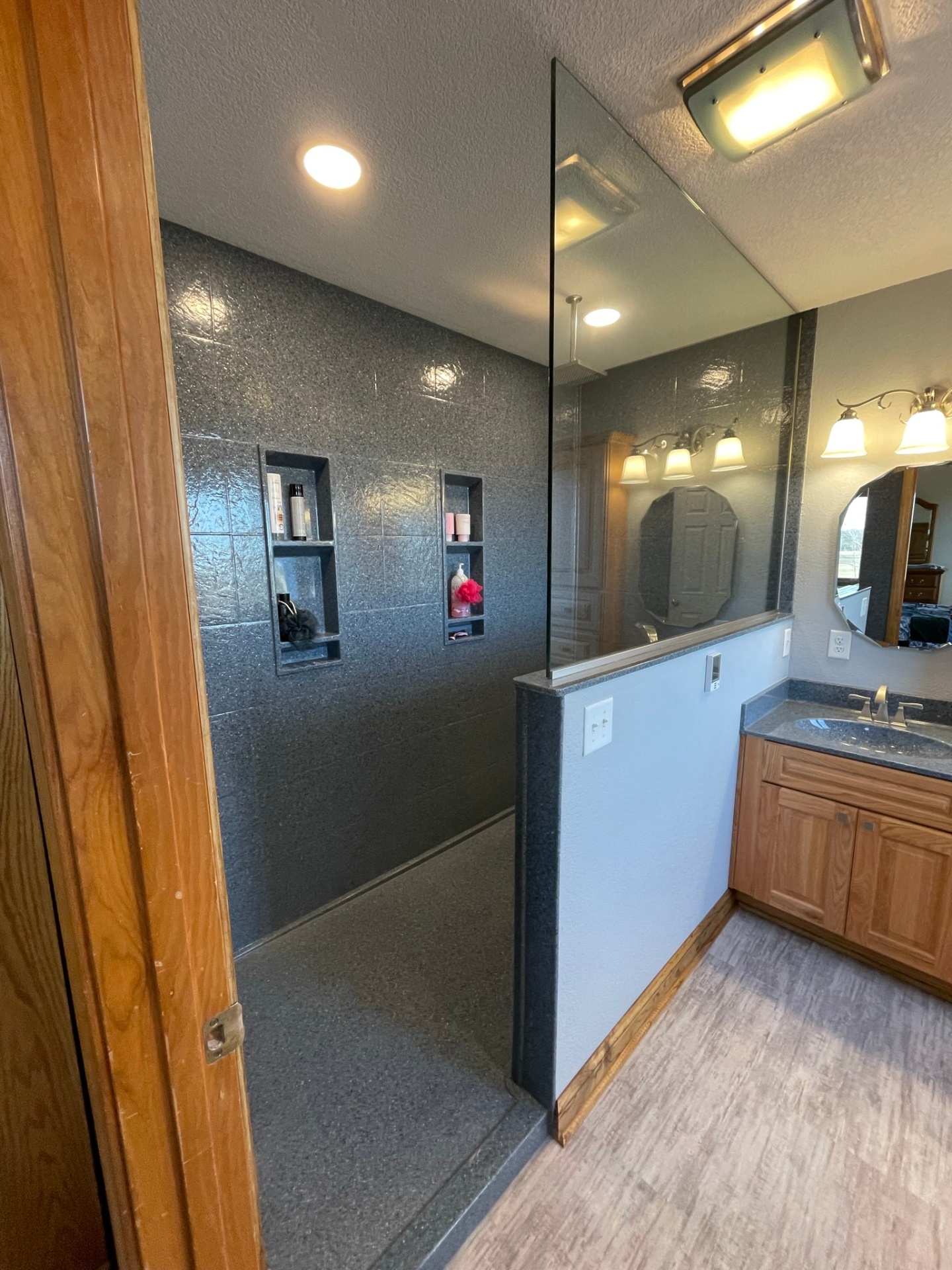
Bathroom Vanity Guide: Sizes, Materials and What Drives Cost
Choosing a bathroom vanity comes down to four things: the right size for your wall and clearances, a cabinet box that holds up to moisture, a countertop and sink that fit how you use the room, and a build level (stock, semi-custom or custom) that fits your budget. Get the size and the box material right, and most of the other choices are about taste.
For most bathrooms, that means a vanity between 24 and 72 inches wide, about 21 inches deep, at a 32 or 36-inch height, with a plywood or solid wood cabinet box. Particleboard and poorly sealed MDF are the materials we most often find swollen and falling apart when we tear out old bathrooms.
This guide combines what we have learned installing vanities in bathrooms across Ottawa, Olathe and the rest of eastern Kansas: sizes, styles, materials, sinks, storage and what drives the cost.
Key takeaways
- Common widths run from 24 inches for a small bath to 72 inches for a double vanity. Standard depth is about 21 inches.
- Comfort height (about 36 inches) suits most adults. The older 32-inch height works well for kids' baths.
- Plywood and solid wood handle bathroom humidity best. Particleboard is the least durable.
- Leave clear floor space in front of the vanity and keep it clear of the toilet and door swing.
- Size, material, build level and countertop are the biggest cost drivers.
Vanity sizes
Width
Vanities commonly come in 24, 30, 36, 48, 60 and 72-inch widths. A 24 to 30-inch vanity fits most small hall baths and powder rooms. A 36-inch single vanity gives more counter space in a standard bath. For a double vanity, 60 inches is a practical minimum, and 72 inches gives two people real elbow room.
Depth
Standard depth is about 21 inches. In narrow rooms, shallow vanities around 18 inches free up walking space. Deeper vanities, closer to 24 inches, add storage and counter space in larger bathrooms.
Height: 32 vs. 36 inches
Older vanities were typically about 32 inches tall. Comfort-height vanities are closer to 36 inches, similar to a kitchen counter, and most adults find them easier on the back. A 32-inch height still makes sense in kids' baths, and vessel sinks often sit on a lower cabinet so the rim lands at a comfortable height.
Single vs. double vanity
A double vanity is great when two people get ready at the same time, and it is common in primary baths. But it needs at least 60 inches of wall, a second drain and supply, and it gives up counter space between the sinks. In many bathrooms, a single sink with a longer counter and more drawers is more useful than two sinks crammed together.
Clearances around a vanity
The International Residential Code generally calls for at least 21 inches of clear space in front of a sink, and the National Kitchen and Bath Association recommends 30 inches for comfort. Keep at least 15 inches from the toilet centerline to the side of the vanity. Also check that drawers and doors open fully without hitting the toilet, door trim or a person standing nearby. Local requirements vary, so confirm with your building department.
For help fitting the vanity into the whole room, see our guide on how to plan a bathroom layout.
Vanity styles
- Freestanding: sits on the floor with a toe kick or legs. The most common and usually the easiest to install and replace.
- Floating (wall-mounted): hangs on the wall with open floor below. It makes small rooms feel larger and is easy to clean under. It needs solid blocking in the wall and careful plumbing placement.
- Furniture-style: looks like a dresser or console with legs and decorative details. It suits older homes and traditional styles.
- Corner: a space-saver for very small bathrooms and powder rooms.
Cabinet box materials compared
The cabinet box is where a vanity lives or dies in a bathroom. Humid Kansas summers, steam from daily showers and the occasional splash or slow leak under the sink all test the material. Here is how the common options behave.
Solid wood
Oak, maple, cherry and other hardwoods bring natural warmth and character. Solid wood is strong and can be refinished, but it expands and contracts with humidity, so it needs a good sealed finish and proper ventilation in the room. It is usually one of the pricier options.
Plywood
Cabinet-grade plywood is our usual recommendation for bathroom vanity boxes. Its cross-layered construction makes it stable, resistant to warping and better at handling moisture than particle-based boards. It holds screws well, which matters for hinges and drawer slides.
MDF (medium-density fiberboard)
MDF is smooth, stable and takes paint beautifully, which is why it is common for painted doors and panels. It holds up fine as long as the finish is intact. Once water reaches bare MDF, especially at edges or around the sink cutout, it swells and does not go back. Moisture-resistant MDF performs better than standard.
Particleboard
The most budget-friendly and the least durable. Particleboard swells quickly when wet and does not hold screws well once damaged. It is the material we most often find crumbling under old sinks.
Thermofoil
Thermofoil is a vinyl layer heat-bonded over MDF. It is easy to clean and resists moisture on the surface, but heat and steam can cause it to peel over time, especially near a hair dryer or a curling iron.
Metal
Stainless steel and metal vanities resist moisture and mold and suit modern designs. They can show scratches and fingerprints, and they are less common in residential bathrooms.
Countertop options
Quartz is our most common vanity top because it is durable and needs no sealing. Granite and marble offer natural stone character but need periodic sealing. Solid surface allows an integrated sink, and laminate or cultured marble are the budget-friendly choices. We compare them in detail in bathroom countertop materials: pros and cons.
Sink options
- Undermount: mounts below the counter for a clean look and easy wiping. Needs a stone, quartz or solid surface top.
- Vessel: sits on top of the counter as a design feature. Needs a taller faucet and a lower vanity height, and it can splash more.
- Integrated: the sink and top are one piece, with no seams to clean. Common with solid surface and cultured marble.
- Drop-in: the rim sits on the counter. Simple and budget-friendly, but the rim collects grime.
Storage
Drawers usually beat doors. They put items in view and within reach, while cabinets under a sink often become a jumble. Look for a U-shaped drawer that wraps around the plumbing, pull-out organizers, and an outlet inside a drawer for hair tools. Our post on bathroom storage solutions has more ideas.
Stock vs. semi-custom vs. custom
- Stock: ready-made sizes and finishes, often with an attached top. The most budget-friendly and quickest to get.
- Semi-custom: standard sizes with more choices for finishes, door styles, drawer layouts and box materials.
- Custom: built to fit your exact space and needs. Best for odd dimensions, unusual layouts or a specific look. It takes longer to build.
What drives vanity cost
- Size: a wider vanity needs more material and often a larger top.
- Box material: solid wood and plywood cost more than MDF and particleboard, but last longer in a bathroom.
- Build level: stock is the most budget-friendly, custom the most expensive.
- Countertop: quartz and stone cost more than laminate or cultured marble.
- Sinks and faucets: a double vanity doubles them.
- Installation: moving drains or supply lines, or adding blocking for a floating vanity, adds labor.
The vanity is one piece of a bigger budget. Our guide on bathroom remodel costs in Kansas explains the other cost drivers.
Local note
In older Ottawa and Franklin County homes, the bathroom fan is often weak or missing altogether, and a vanity takes the hit. Pairing a moisture-resistant vanity with a fan ducted outside is the combination that lasts.
Frequently Asked Questions
What is the best material for a bathroom vanity?
Plywood and solid wood are the best choices for a bathroom vanity cabinet box because they handle humidity and moisture well. Plywood is especially stable and holds screws securely. Particleboard is the least durable and tends to swell when wet.
How much does a bathroom vanity cost?
It depends on size, box material, build level (stock, semi-custom or custom), the countertop and the sink. A small stock vanity with an attached top is the most budget-friendly, while a large custom double vanity with a quartz top is a much bigger line item. Installation costs rise if plumbing needs to move.
What size vanity do I need?
Measure the wall and subtract space for toilet and door clearances. Most small bathrooms fit a 24 to 36-inch vanity, while double vanities need at least 60 inches. Standard depth is about 21 inches, with shallower options for tight rooms.
Is MDF or plywood better for a bathroom vanity?
Plywood is generally better for the cabinet box because it resists moisture and warping and holds screws well. MDF is smooth and great for painted doors, but it swells if water gets past the finish. Many quality vanities use plywood boxes with MDF doors.
How much space do you need around a vanity?
Plan for at least 21 inches of clear space in front of the vanity under the IRC, with 30 inches recommended by the NKBA. Keep at least 15 inches from the toilet centerline to the vanity side. Check your local code for any differences.
The right vanity depends on your room, your routine and how long you plan to stay. Take a look at our bathroom remodeling services and our work in Olathe, KS, then start a conversation about your bathroom.
Planning this project? See our bathroom remodeling services
Ready To Start Your Project?
No pressure, just an honest conversation about your home.
Let's Start A ConversationRelated Articles
How to Plan a Bathroom Layout: Space Planning, Clearances and Mistakes to Avoid
February 20, 2025
Best Bathroom Storage Solutions to Maximize Your Space
January 30, 2025
Bathroom Countertop Materials: Pros, Cons and the Best Pick for Each Bath
January 16, 2025